HalalHub.vn · In-depth analysis · 10 November 2026
(HalalHub.vn) – Saudi Arabia is the Gulf’s largest economy, home to Islam’s two holy cities and a major food import market. In 2026, the countries repeatedly advanced Halal cooperation, from proposals to reopen access for shrimp and pangasius to joint production ventures. Market entry nevertheless requires navigating a strict certification system overseen by SFDA. This article examines requirements, opportunities and preparation.
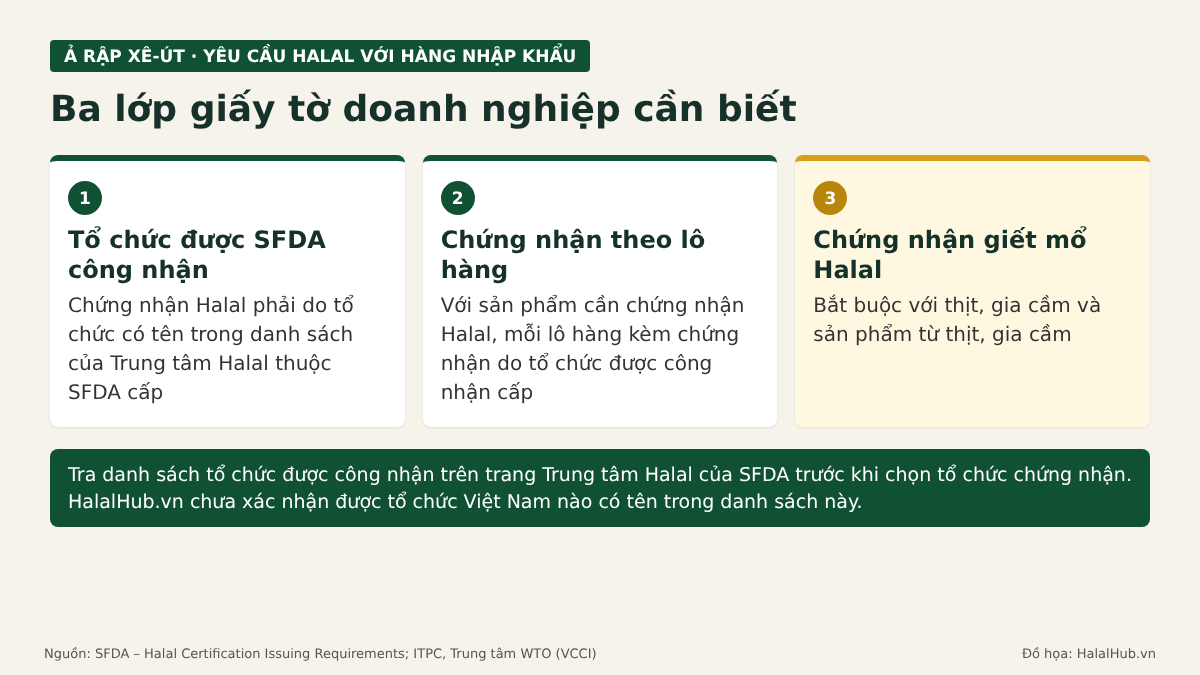
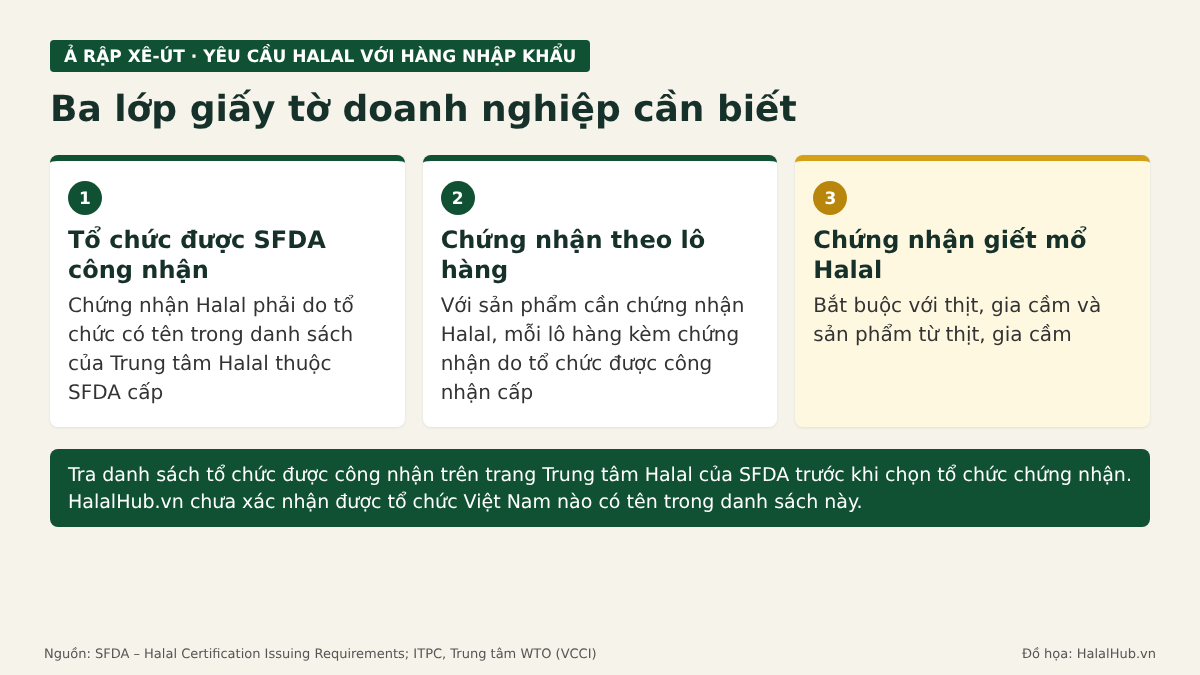
Three layers of Halal requirements for Saudi imports. Graphic: HalalHub.vn, based on SFDA.
1. Why Saudi Arabia matters
Saudi Arabia is a major Middle Eastern food import market and a gateway to the Gulf Cooperation Council (GCC). Media reports put bilateral Vietnam–Saudi Arabia trade above US$3 billion, with agriculture accounting for only around 15%. Millions of pilgrims visiting Mecca and Medina annually also generate substantial demand for Halal food.
Following Vietnam’s Halal legal framework under Decree 127/2026/ND-CP, effective 1 June 2026, dialogue intensified. In June, the Ministry of Agriculture and Environment requested the reopening of shrimp and pangasius access and SFDA expert assessments of Vietnam’s control system. On 10 November, the Ministry of Ethnic and Religious Affairs proposed joint Halal production ventures in Vietnam.

Riyadh at night. Saudi Arabia is the Gulf’s largest economy and a major Middle Eastern food import market. Illustrative photo: Unsplash.
2. Certification: Three layers of documentation
The regulator is the Saudi Food and Drug Authority (SFDA), with its affiliated Halal Center. According to SFDA rules and information from ITPC and VCCI’s WTO Center:
| Requirement | Details |
| Certification body | Halal certification must be issued by a body on SFDA’s recognized list, published on its Halal Center website. |
| Shipment certification | Each shipment of products requiring Halal certification must carry a certificate issued by a recognized body. |
| Meat and poultry | Halal slaughter certification is mandatory for meat, poultry and their products. |
Sources: SFDA – Halal Certification Issuing Requirements; ITPC; WTO Center (VCCI). Businesses should check current rules before each order.
| ⚠️ CHECK CAREFULLY HalalHub.vn has not confirmed which Vietnamese certification bodies appear on SFDA’s recognized list. JAKIM or MoIAT recognition does not automatically mean SFDA acceptance. Check the SFDA Halal Center list or contact SFDA directly before signing a certification contract for Saudi-bound goods. |
3. Opportunities by product group
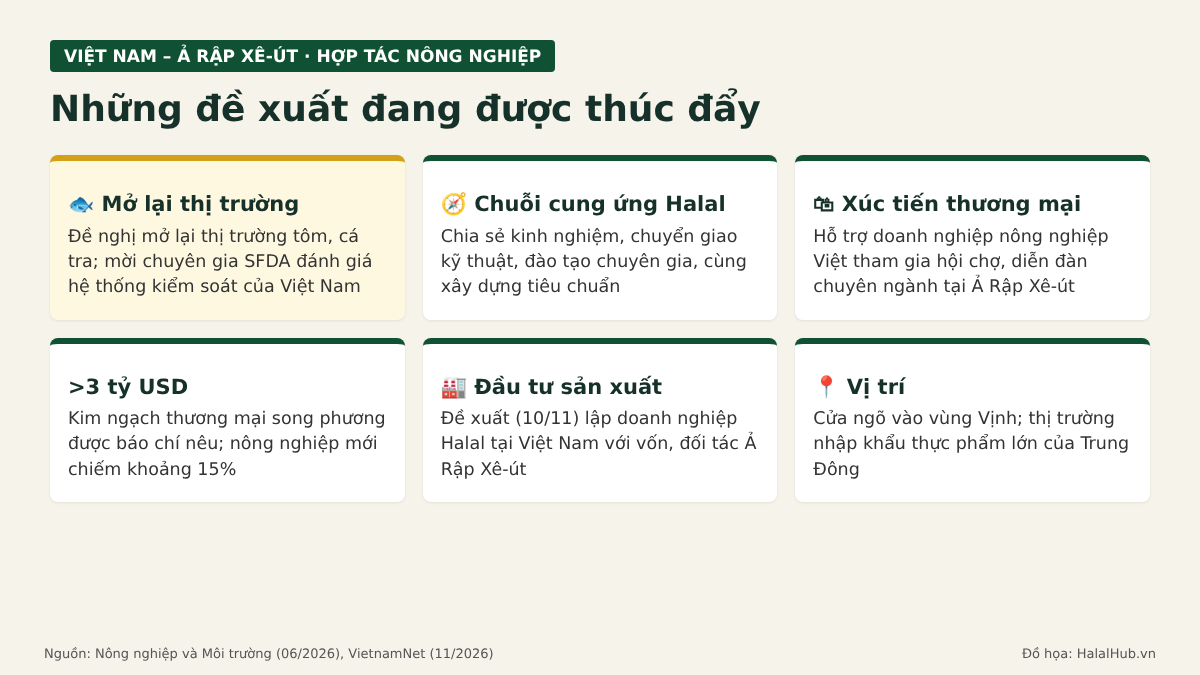
Agricultural and Halal cooperation proposals between the countries. Graphic: HalalHub.vn.
| Product group | Requirement level | Notes |
| Rice, coffee, cashews and spices | Low–medium | Control cross-contamination and additives; established Vietnamese strengths. |
| Processed food and confectionery | Medium–high | Certification by an SFDA-recognized body; review gelatin, emulsifiers and flavorings. |
| Seafood: shrimp and pangasius | High | Market reopening has been requested; dependent on SFDA’s assessment of the control system. |
| Meat and poultry | Very high | Mandatory Halal slaughter certification; not yet a Vietnamese export strength. |
Source: compiled by HalalHub.vn.
4. A roadmap for businesses
Establish product-specific requirements with the Saudi importer: whether Halal certification is required and whether it applies per shipment or per product.
Consult SFDA’s recognized-body list and select a suitable body to avoid duplicate certification for the same market.
Prepare product registration and labeling under SFDA rules, including Arabic text, ingredients and expiry dates.
Use trade promotion opportunities at Saudi fairs and forums and support under Decree 127/2026.
Monitor the memorandum and joint-venture proposals to connect proactively if opportunities arise.
5. Conclusion
Saudi Arabia is expanding cooperation without lowering certification requirements. Businesses that understand SFDA rules, select the right certification body and prepare shipment documentation will be best placed to use government-level agreements when these become concrete.
Glossary
SFDA: Saudi Food and Drug Authority; its Halal Center manages recognition of certification bodies.
GCC: Gulf Cooperation Council, comprising Saudi Arabia, the UAE, Qatar, Kuwait, Oman and Bahrain.
Shipment certification: Halal certification for a specific consignment, accompanying export documents.
Halal slaughter certificate: confirmation of slaughter in compliance with Halal requirements, mandatory for meat and poultry.
Product registration: declaring a product to the importing country’s regulator before circulation.
References
Official and primary sources
SFDA – Halal Certification Issuing Requirements
Press and industry analysis (secondary sources)
ITPC – Halal certification must be from SFDA’s recognised bodies for goods to enter Saudi Arabia
WTO Center (VCCI) – Halal certification must be from SFDA’s recognised bodies
VnEconomy – Halal cooperation with Vietnam is among Saudi Arabia’s leading priorities
Illustrative photos: Unsplash (Unsplash License). Graphics: HalalHub.vn.
HalalHub.vn · Dated 10 November 2026 · Legal information checked as of 10 November 2026; regulations may change. Consult official sources before making decisions.
| ℹ️ ABOUT HALALHUB.VN’S INDEPENDENCE HalalHub.vn is a platform for connections and information. HalalHub.vn is not a Halal certification body and does not issue Halal certificates. Halal certificates are issued by bodies recognized by the competent authority in the importing country (for example, BPJPH in Indonesia and bodies recognized by JAKIM in Malaysia). This article is for reference and does not replace legal advice. |
HalalHub.vn service information
| 🤝 CONNECT WITH HALALHUB.VN Already Halal-certified: register and create a business profile in the HalalHub.vn directory, specifying the issuing body, scope and validity of your certificate so partners can assess it. Not yet certified: follow HalalHub.vn’s News and Knowledge sections for regulatory updates and certification roadmaps for each market. Register at: https://halalhub.vn |